Sunday, January 27, 2013

Tuesday, December 18, 2012
Waiting For "Superman"
"Waiting for Superman" is one of the only films I remember watching recently that actually made me cry. The documentary is about five public school children in various parts of the United States who are, for one reason or another, having problems with their school. All five of the children have applied to charter schools that determine who is accepted based on a lottery. The film documents the children's stories, the reasons for their problems at school, and finally the lottery they are participating in. The children, Anthony, Daisy, Francisco, Emily, and Bianca, are all very young, and all have plans for their future that might be impossible because of the schooling they receive. In this way, "Waiting for Superman" discusses the issue of public schooling in the United States, and whether it needs to be reviewed. The film pretty conclusively says that it should, and while I do not agree with all of the conclusions drawn in it, I think it is a very well-made and emotional movie. The plot is straightforward, with the children and the lottery at its center. The children are wonderfully endearing characters, and I certainly felt very attached to them when I watched the movie. There of course isn't any acting, sets, or makeup, because it is a documentary, but it still manages to convey a sense of drama through the subject matter and quotes from the kids, as if it were a fictional film. In fact, I almost forgot that it was a fictional film towards the end, when the lottery came around for all the kids. I convinced myself that of course they would all get into their schools of choice. At risk of spoiling the movie, I have to say that that does not quite happen, and the outcome was the part that made me cry. The editing of the movie increases the drama, with little music in the very serious parts, and archival footage of Superman at the beginning. The lack of special effects makes the documentary seem more real and involved than it would if there were lots of added effects that could not have been there originally. All of the aspects of the film come together to give it a very fatalistic mood, which was one of the things that made it so sad. Whether or not the person watching the documentary believes that the public school system is as flawed as "Waiting for Superman" suggests, it is impossible to watch it without getting a feeling that something, at least, has to be changed in our education system. Controversial as "Waiting for Superman" is, I heartily recommend it to anyone who doesn't mind a little sadness, if it inspires them to do something to change their communities.
"Waiting for Superman", 1hr51, PG
Sunday, December 16, 2012
She-Wolves Continued- Feminism and Queenship in Medieval England
Last week, I ended my post on She-Wolves: The Women Who Ruled England Before Elizabeth by saying that I would pick up the review where I left off, by talking about Isabella of France and Margaret d'Anjou. While both these women are fascinating people and historical figures I greatly admire, I would rather make this post about a more general topic that the book discusses- queenship in medieval England and Europe.
For almost everyone in the United States, the idea of England with a queen is one that is not only believable, but central to their understanding of England. After "tea and crumpets" and "Shakespeare", the Queen is probably the thing most people think of when they think of England. But for centuries, England, along with many of the nations of Europe, would have found the idea of a queen regnant ridiculous and, more importantly, dangerous.
According to medieval tradition, the perfect ruler has to be wise in judgement and strong in battle. Women, of course, could not serve in battle in medieval times; therefore, by the logic of many medieval thinkers and politicians, a woman could not be an effective ruler. In an era as war-torn and perilous as the middle ages, a country without a strong military leader was doomed. When the king of France, Charles VI, became "weak of mind", his lands were taken over by Henry V of England, renowned the world over as a model king for his military strength. When Henry's son, Henry VI, went into a coma for a year and then emerged an even meeker man than he was when he went in, his kingdom fell into a civil war that lasted for a decade. Those men who considered women weaker than them in that time could not fathom the idea of voluntarily giving control of a country to someone who was obviously not going to be able to control it as well as a man could. When Isabella and Margaret led armies into battle, they were reviled as "she-wolves" and harpies who had stolen the reigns of government from worthier men. To make matters worse, Isabella took up arms against her own husband, an unforgivable crime in medieval times, and Margaret, although fighting on the same side as her husband, did not allow him any say her decisions to make war. These women exemplified to medieval men the dangers of female rule, although to the modern eye they appear no worse than any other rebellious subjects of the fourteenth and fifteenth centuries.
Women could not rule, it was said, because they could not be fair in judgement and strong in battle. Even after Eleanor of Aquitaine held a glittering and just court for decades in Aquitaine, and Isabella and Margaret led their armies into many successful battles, the prejudice remained. Medieval society was set against female rule not for any concrete reason, but simply because of blind sexism.
For almost everyone in the United States, the idea of England with a queen is one that is not only believable, but central to their understanding of England. After "tea and crumpets" and "Shakespeare", the Queen is probably the thing most people think of when they think of England. But for centuries, England, along with many of the nations of Europe, would have found the idea of a queen regnant ridiculous and, more importantly, dangerous.
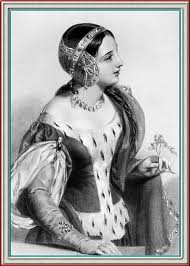 |
| Isabella of France |
 |
| Margaret D'Anjou |
Women could not rule, it was said, because they could not be fair in judgement and strong in battle. Even after Eleanor of Aquitaine held a glittering and just court for decades in Aquitaine, and Isabella and Margaret led their armies into many successful battles, the prejudice remained. Medieval society was set against female rule not for any concrete reason, but simply because of blind sexism.
Tuesday, December 11, 2012
Book of the Week: She-Wolves
 This past week, while I was sick at home, I decided to read a book that I've owned for a while, but never actually finished. I'd bought it at Borders a couple of years ago, because it looked interesting and mentioned Margaret d'Anjou, and I was in the middle of a production of Henry VI. Surprisingly, it ended up to be rather excellent. She-Wolves: The Women Who Ruled England Before Elizabeth, by Helen Castor, is a book about four queens who ruled England (unofficially) before England ever actually had a queen regnant.
 The first section of the book is about Matilda, Lady of the English. Matilda was the daughter of Henry I of England, a popular king and second son of William the Conqueror, first Norman king of England. After Henry's only legitimate son died in a shipwreck, he decided to make Matilda, who had been married to the Holy Roman Emperor Henry V, his heir. This was the first time that the idea of female rule had seriously been considered in England, at least since the Conquest. Henry did his best to bind the nobility to Matilda, but after his death the throne was taken by Stephen, his nephew. Matilda fought against Stephen with the forces of her second husband, Geoffroi of Anjou, but Stephen managed to hold the crown until he died. After his death, the crown passed to Matilda's son, Henry II.
 The second queen in the book is Eleanor of Aquitaine, wife of Henry II. Eleanor was already one of my favorite historical figures, and this book focused on her time as Queen of England, a time period I did not know as much about. Eleanor was actually married to Phillip of France for several years, but divorced him to marry Henry II and become queen of England. Eleanor was the mother of Richard the Lionheart and King John, two of England's best-known kings. While Henry II was still alive, two of his sons, Henri and Richard, started a rebellion against him, which Eleanor participated in. She was then imprisoned for fifteen years, until Henry II's death. During the reign of Richard the Lionheart, Eleanor acted as an advisor and even ruled when Richard went away on crusade. Her court in Aquitaine was lauded as the birthplace of romantic love and classical chivalry.
I haven't finished the book yet, but I will, and will probably write about the next two queens, Isabella and Margaret, next week. The book is fascinating not only because it discusses two very interesting women, but also because it talks about the issue of female rule perhaps even more than some other books I've read that focus solely on the Tudor queens. I heartily recommend this book to anyone who is interested in English history or historical feminism.
Sunday, November 11, 2012
Placebo Trailer
Placebo- Natalie, Emily O, Maddie P, Sophie
The world was in terrible danger. A horrible disease was killing people off by the thousands, until the government, led by the Surgeon General, found a cure. The cure must be taken four times a day, every day, which seemed a small price to pay for your life. But when Cassandra finds herself without her pills, she will learn that the cure, and the government may not be all that they seem. Cassandra enters the hidden world of underground doctors, forced by the government to hide their trade and serve those that the government will not. An ex-government doctor tell Cassandra a terrible secret, one that, if acted on, will cost Cassandra her life. But is her death the price the world has to pay for freedom?
Saturday, November 10, 2012
Sunday, November 4, 2012
 |
| Anne Boleyn |
As some people probably know, Anne Boleyn is one of my personal heroes. I first learned about Anne from reading various historical fiction books about her daughter, Elizabeth. I never thought much about Anne until I read Doomed Queen Anne, a novel about Anne Boleyn from the author of one of my favorite Elizabeth books, Beware, Princess Elizabeth.
Doomed Queen Anne sparked an interest in Anne Boleyn that has lasted for years. I have read countless fiction and nonfiction books and seen several movies about Anne, and all of them present slightly different portraits of her. For this post, I would like to examine two different fictional portrayals of Anne Boleyn.
First, the basics. Anne Boleyn was born in 1501 at Hever Castle, in Kent. Her father was Lord Thomas Boleyn, a minor English noble, and her mother was Lady Elizabeth Howard, daughter of the Duke of Norfolk. She had two siblings, Mary and George. As I will discuss later, the order of birth of the siblings is somewhat disputed, but George was almost certainly younger. Anne was sent to France at a very young age with her sister Mary, and spent most of her youth and early teen years at the court of Francois I. By all accounts, this French education had a heavy impact on Anne. When she returned to England, she eventually caught the eye of Henry VIII, and became his mistress. She convinced Henry to divorce his wife to marry her, and indirectly caused the formation of the Church of England. Unfortunately, Anne was not a popular queen, and when Henry became disenchanted with her following the birth of Elizabeth and the miscarriage of a second male child, the populace easily swallowed stories of her witchcraft and adultery. Anne was arrested on charges of witchcraft, adultery, incest, and treason along with her brother George, Mark Smeaton, a court musician, and Henry Norris. She was executed on May 9th, 1536 at the Tower of London and buried at the church of St. Peter ad Vincula. Henry married his third wife, Jane Seymour, eleven days after Anne's execution.
 Doomed Queen Anne- Of all the Anne Boleyn books I've read so far, this one presents the most compelling picture of Anne to me. The Anne in this book is intelligent and calculating. She understands that the only way to survive as a woman in a man's world is to secure the highest position, by marrying the most powerful husband. She uses her differences, such as her unfashionably dark complexion and dark hair, to attract the king's attention. Anne's fall at the end of the book is a result of her temper and the king's infidelity, not any actual misdeeds on her part. This portrayal makes her seem clever and strong, and an exemplary role model for any young girl.
 The Other Boleyn Girl (The book and the movie)- The Other Boleyn Girl seems to be the most popular Tudor book of late, despite its historical inaccuracy and unorthodox take on Anne and Mary Boleyn. The book actually centers on Mary, Anne's sister, and is the only account I've ever seen that says that Mary was the younger sister. The Other Boleyn Girl makes Anne seem, quite frankly, evil. She is jealous of her sister's genuine love for the king, she flies into a rage for no reason, and at one point she even takes Mary's two children away from her for no real reason. The book also implies that the charges of incest levied against Anne and George Boleyn are true. Needless to say, I do not like this take on Anne's personality.
Subscribe to:
Posts (Atom)